Showing posts with label diamonds. Show all posts

Thursday, September 25, 2008

75th Post

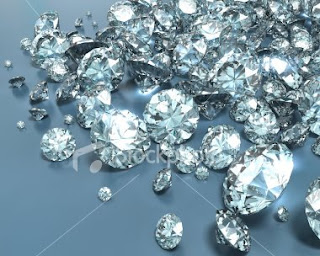
photo courtesy of Bill Ely.

This is my diamond post. 75 is usually represented by Diamonds. So let's talk about them!
The Four C's

CARAT is the diamond weight.
  • Carat is a measure of weight not of size.
  • One carat is equivalent to 200 milligrams.
  • One carat can also be divided into 100 “points.” A .75 carat diamond is the same as a 3/4 carat diamond.
  • Cut and mounting can make a diamond appear larger or even smaller than its actual weight.

CLARITY How many flaws {inclusions} does the diamond have?

  • Naturally-occurring features {inclusion} provide a special fingerprint within the stone.
  • Inclusions may look like tiny crystals, clouds or feathers.
  • The position of inclusions can affect the value of a diamond.
  • Inclusions are ranked on a scale of perfection, known as clarity.
  • Some inclusions can be hidden by a mounting, thus having little effect on the beauty of a diamond. An inclusion in the middle or top of a diamond could impact the dispersion of light, sometimes making the diamond less brilliant.
  • The greater a diamond's clarity, the more brilliant, valuable and rare it is.

COLOR How colorless is the diamond?

  • Diamonds are found in almost every color of the rainbow, but white-colored diamonds remain most popular.
  • Truly colorless stones are treasured for their rarity.
  • Diamonds also naturally come in intense shades of blue, green, yellow, orange, pink or red.
  • These diamonds are called ‘colored fancies’ and are extremely rare and highly treasured.

CUT is the shape the diamond is cut into.

  • Nature determines so much about a diamond, but it takes a master cutter to reveal the stone’s true brilliance, fire and ultimate beauty.
  • Diamonds that are cut too deep or too shallow lose or leak light through the side or bottom, resulting in less brilliance and it loses its value.
  • Cut also refers to shape—round, square, pear, or heart for example.
  • A round diamond is symmetrical and capable of reflecting nearly all the light that enters. It is the most brilliant.
  • Non-round shapes, are called fancy cuts.

Diamond Facts

  • Diamonds were formed long before the dinosaurs were here. The youngest diamond is about 900 million years old. The oldest was formed over 3 billion years ago.
  • Diamonds are like snowflakes, no two are alike.
  • The rarest diamond color is red.
  • The first diamonds came from India over 2800 years ago.
  • Each stone usually loses about half of its weight during the cutting and polishing phase.
  • Less than 5% of all the diamonds made into jewelry are larger than one carat.
Happy Reading,

The Four C'S and Diamond facts taken in part from A Diamond Is Forever.

Friday, August 22, 2008

Traditions & Superstitions-The Engagement & Wedding Ring

  • It represents a formal agreement to a future marriage.
  • The engagement ring, or betrothal ring dates from the earliest days of marriage by purchase. It was partial payment for the bride and a symbol of the grooms honorable intentions.
  • The first ring is from a mythological legend. Prometheus smelted a ring from the forbidden fire of the gods for the love of mankind.
  • The engagement ring at first, was for both the betrothal and wedding.
  • The diamond was first discovered in India. It was valued more for its durability and strength than for its beauty.
  • The word diamond is from the Greek word adamas "unconquerable". In Latin the word is diamas.
  • Egyptians thought of the circle, a shape that does not have a beginning or an end, as a reminder that life, happiness, and love do not have a beginning or an end. Eternity.
  • The tradition of placing the wedding band and engagement ring on the fourth finger of the left hand is from ancient times. It is believed that particular finger contains the vena amoris or "vein of love" and that it leads directly to the heart.
  • With Romans, the tradition was established to give a ring as a public pledge that the marriage contract would be honored.
  • Plain rings of gold, silver or iron were what couples used first.
  • One of the first recorded accounts of an engagement ring was in 1477, when Archduke Maximilian of Austria presented Mary of Burgundy with a diamond ring. Maximilian wed Mary within 24 hours.
  • Diamonds were reserved for royalty and the wealthy until 187o, when they discovered the diamond mines in South Africa. That's when diamonds became more accessible and affordable to the rest of us.
  • Posy rings, which were inscribed with love poems and messages, were popular betrothal rings from the Middle Ages until Victorian times.
  • The smallest engagement ring on record was given to two-year-old Princess Mary, daughter of Henry VIII. She became betrothed to the infant Dauphin of France, son of King Francis I, in 1518. Her tiny gold ring was set with a diamond.
  • Hearts were favorite motifs for engagement and wedding rings during the 17th and 18th centuries.
  • Some couples in the 17th century wore their wedding rings on their thumb.
  • Colored stones were the gem of choice for engagement rings in the 18th and 19th centuries.
  • The Victorians believed in the hidden means of gemstones.
  • An opal brought good fortune.
  • Rubies are the color of the heart.
  • A sapphire is the color of the heavens.
  • An emerald helps with fertility.
  • A garnet meant you would be life-long best friends.
  • An amethyst helped the wearer avoid drunkenness.
  • Pearls were avoided since they resembled tears and were formed in the "tears" of the oyster forming them.
  • The "Tiffany" or solitaire setting was invented in 1886.
  • Platinum was the metal of choice for engagement rings during the early 20th century.
  • In 1947, DeBeers started their ad "A Diamond is Forever" in the United States.
  • During World War II platinum was declared a strategic metal and wasn't allowed to be used in jewelry. This led to the rise of both yellow and white gold in bridal jewelry.
  • By the end of World War II the diamond engagement ring was what most American couples choose.
  • The double ring ceremony is from a failed male engagement ring campaign by American jewelers.
  • Then in the 1920's jewelers decided to focus on just the wedding ring, which wasn't a common Western tradition.
  • During the 1940's images of soldiers wearing wedding bands were shown to Americans as a way to show the soldiers commitment from afar.
  • After the war the groom's ring became a symbol of masculinity. The ability of a man to provide for his wife and children.
  • The wording of the wedding ceremony was changed from ring to rings for this new tradition.
  • In 1981, DeBeers came up with the two months salary ad.
  • In the last few years platinum has become popular again.

Happy Reading,